

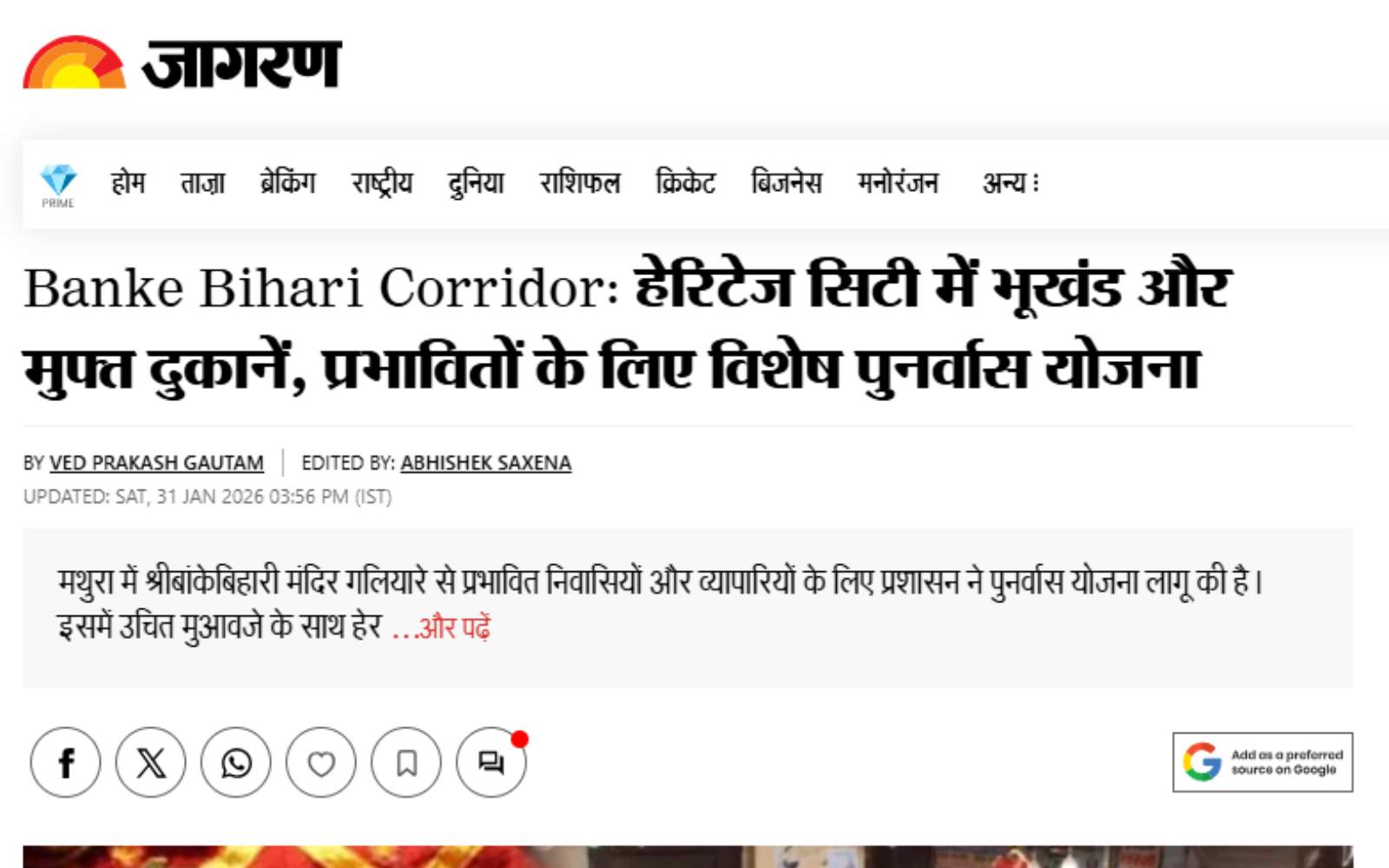
The Uttar Pradesh government has announced the expansion of its rehabilitation framework for families and traders affected by the Banke Bihari Corridor project in Vrindavan. As per the latest decision, individuals whose properties are acquired for the corridor will now also be eligible to receive residential plots within the planned Heritage City development, this marks a crucial step toward balancing infrastructure development with social responsibility.
Banke Bihari Corridor: Addressing Crowd and Infrastructure Challenges
The Banke Bihari corrdor project has been initiated to improve crowd management, safety and accessibility around the historic temple. During major festivals such as Janmashtami and Holi, the narrow lanes surrounding the temple feel extreme congestion, posing serious safety risks for devotees and residents.
The state government proposed the development of a corridor similar in concept to other temple redevelopment projects undertaken across Uttar Pradesh
Heritage City Plots
According to officials familiar with the development, people whose homes are affected by the corridor will be provided priority allotment of plots in the upcoming Heritage City project.
This initiative is designed to provide displaced families with an opportunity within a planned urban environment rather than being pushed to unorganized or peripheral areas.
Balancing Development and Local Concerns
Despite the government assurance, the corridor project has generated mixed reactions among the local residents, temple servitors, shopkeepers and heritage conservation groups. Concerns have been raised over the potential loss of ancestral homes, traditional markets, and historically important structures that form the cultural fabric of Vrindavan.
In response, the administration has given importance to the fact that rehabilitation measures, including plot allotment in the heritage city, are being structured to minimize the long-term disruption. Over recent months, consultations and discussions between officials and local stakeholders have continued.
A Heritage City
The Heritage City project is a key component of the state’s long term strategy to manage urban growth in Mathura and Vrindaban. Urban planners involved in the project indicate that heritage will incorporate wide internal roads, green zones, public utilities and designated commercial areas. Preference is given to resilience and sustainability, including drainage planning and infrastructure capable of supporting future population growth.
For the real estate sector, the project represents a shift towards planned urban expansion, reducing the pressure on the old city while creating new opportunities for housing and investment in the region.
Impact on Real Estate and Investment Sentiment
The announcement of pilot allotments for affected families is also being closely watched by real estate stakeholders. Analysts note clarity on rehabilitation and land acquisition often plays an important role in determining the pace of large infrastructure projects.
With the corridor and Heritage City initiatives moving forwards in parallel, the Mathura-vrindavan is seeing a lot of growing interest from developers, investors, and end users. Improved infrastructure, government backing and a structured urban development approach are increasingly positioning the region as a long-term growth corridor. Experts believe that once rehabilitation mechanisms are fully implemented, project execution timelines could gain momentum, strengthening investor confidence.
Cultural Sensitivity Remains Central
Officials have stressed that the corridor project is not intended to commercialize the or dilute Vrindhavan spiritual identity Instead, the objective is to enhance the pilgrim experience.
Architectural planning for the corridor and the Heritage city is expected to use traditional design elements, ensuring a visual and cultural harmony with the region’s heritage. Authorities say such measures are important to maintaining Vrindavan’s unique character while accommodating modern infrastructure needs.
Rehabilitation Framework Focuses on Livelihood Protection
The state government is working to handle the livelihood of traders and shopkeepers who got impacted by the Banke Bihari Corridor project. Officials give the signals that commercial rehabilitation options, including designated vending zones and planned retail spaces are under consideration. The aim is to ensure that the affected are able to resume operations without any long-term disturbance.
Roadmap Ahead: Implementation and Timelines
While the broader vision of the Banke Bihari Corridor and heritage city projects has been outlined, officials indicate that the phased implementation will be a key to ensuring smooth execution. Surveys, property assessments, and final rehabilitation eligibility lists are currently being streamlined to avoid delays. Authorities have given importance to the fact that possession of alternative plots and rehabilitation benefits will be given priority before any large-scale activity begins.
Strengthening Pilgrimage Infrastructure and Visitor Experience
The Banke Bihari project is expected to significantly improve the overall pilgrimage experience in Vrindavan. Planned upgrades include better pedestrian movement, emergency access routes, organized entry, and exit points. And improved civic amenities such as sanitation, lightning, and signage.
Environmental Planning and Sustainable Urban Design
An important but less discussed aspect of the Banke Bihari Corridor and Heritage City projects is their environmental footprint. Urban planners associated with the development indicate that sustainability principles are being factored into the design, particularly in towns as ecologically and culturally sensitive as Vrindivan. Measures such as improved stormwater drainage, increased green buffers, pedestrian- friendly zones and reduced vehicular dependency around the temple are being explored.
Heritage and Climate Resilience: Designing Vrindavan for the Future
As vrindavan modernizes through the Banke Bihari Corridor and Heritage City projects, planners are not just thinking about aesthetics or crowd management but they are integrating climate resilience into heritage preservation. Given the town’s ecological sensitivity, initiatives like elevated walkways to prevent flood disturbance, pavements to reduce waterlogging, and green buffer zones to combat heat are being incorporated with traditional architectural elements.
Moreover, energy-efficient lighting, rainwater harvesting and shaded public spaces are designed to protect both pligrims and local community from extreme weather events while maintaining the spiritual ambience.
Conclusion
The Banke Bihari Corridor and Heritage City projects represent a vision for vrindavan. By providing rehabilitation plots for affected families, safeguarding livelihoods and integrating climate, the state government is making sure that development does not come at the cost of the city’s cultural and spiritual identity.