

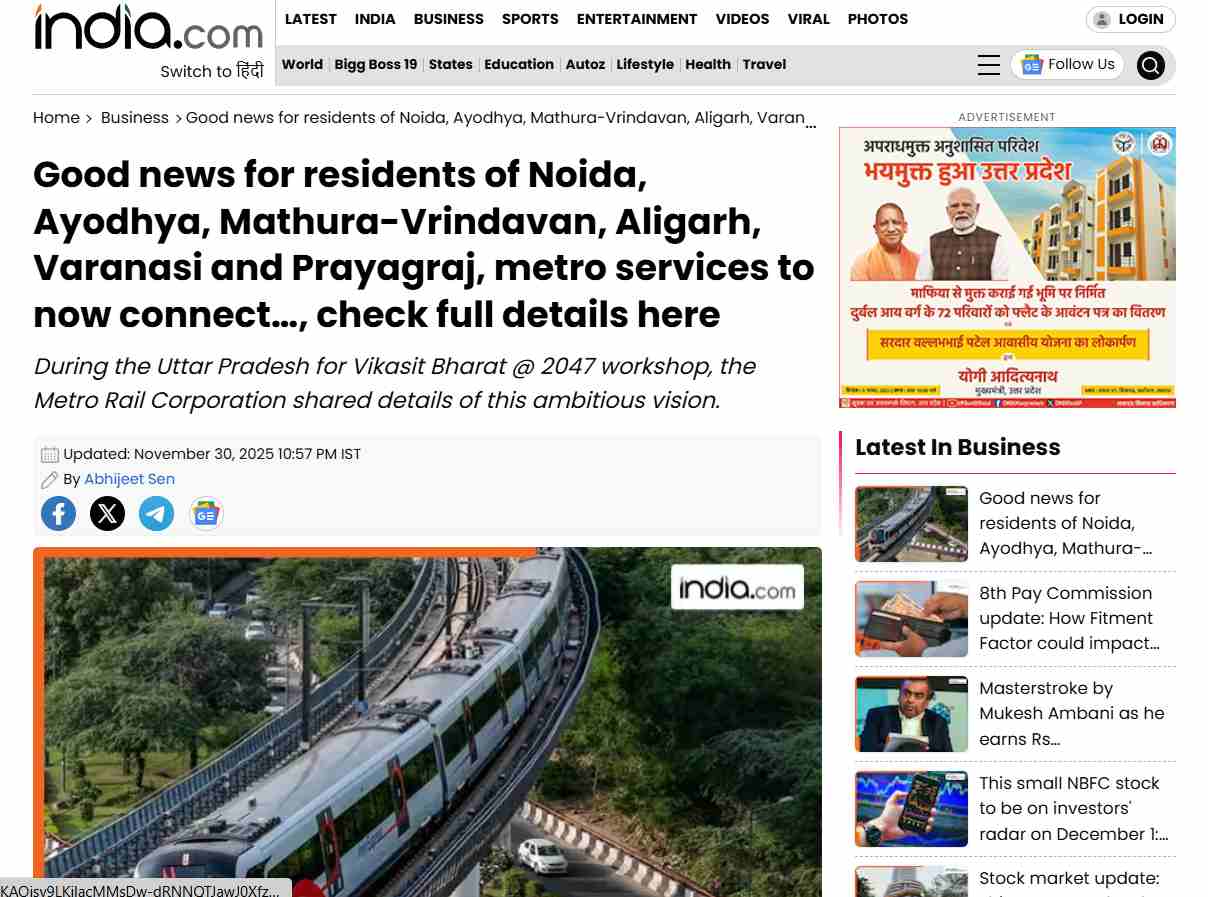
The Uttar Pradesh Metro Rail Corporation (UPMRC) recently announced a new infrastructure plan to improve urban transportation in Uttar Pradesh. The plan extends from the religious sites of Mathura to the industrial centers of Noida and is aimed at creating an integrated transportation future.
Mathura / Lucknow: The spiritual heartland of India is set for a futuristic upgrade. In a landmark announcement that promises to redefine how pilgrims and residents travel, the Uttar Pradesh government has unveiled a roadmap for a massive expansion of the metro rail network. At the centre of this vision is a plan for a 50-km metro network covering the Mathura-Vrindavan region, a move expected to finally end the perennial traffic woes of the twin temple cities.
Sushil Kumar, the Managing Director of UPMRC, presented the roadmap to the stakeholders during the "Viksit Uttar Pradesh for Viksit Bharat @ 2047" workshop. This roadmap illustrates a plan that will allow for the development of a 1,575 km metro rail network throughout the state by 2047. If completed as envisioned, Uttar Pradesh will have the largest urban transportation network in India.
The Master Plan: A Web of Connectivity
The proposal marks a strategic shift from limiting rapid transit to Tier-1 cities. The government has recognized that to become a trillion-dollar economy, connectivity must reach the emerging religious and industrial growth engines.
• Goals of Metro Lines: The objective of the firm is to have 790 kilometers worth of operational Metro Line by year 2035. This target will progress to a total coverage of 1,575 kilometres of Metro Line by year 2047.
• Financial Plan: The Financial Plan to support this very ambitious course of growth includes estimated funding from ₹1,040 Crore - ₹1,527 Crore per year to achieve plan amounts.
• Metro Expansion to New Cities: The planned Metro System will also expand from existing major metropolitan centres into new City Infrastructure locations, including but not limited to, Mathura-Vrindavan, Ayodhya, Aligarh, Gorakhpur, Bareilly, Moradabad, Meerut, Jhansi & Saharanpur; All Cities will have 50 Kilometres approximately of Metro coverage.
• Expansion of Giants:
Lucknow: Will see its network balloon to 225 km.
Kanpur: Targeted to reach 200 km.
Noida, Greater Noida, Varanasi, and Prayagraj: Each allocated a 150 km expansion target.
Mathura-Vrindavan: The ‘Light Metro’ Advantage
Due to the fact that Mathura and Vrindavan have a lot of narrow alleys combined with historic infrastructure, which will create certain complications when designing for construction in the area, it is reasonable to expect that UPMRC will explore the 'Metro Neo' or 'Metro Lite' options. Compared to heavier metro systems found in Delhi and North India, the lighter options utilize either rubber tires or lighter gauge rail and are primarily positioned at grade or in elevated areas that require less area to be used for operations.
The Parikrama Marg and other key access points in Vrindavan currently experience large traffic jam disruptions during weekends and major holidays; therefore, this 50km-long corridor is not only designed as a significant modernization effort but also as a much-needed addition to a busy network of key access points. A dedicated metro loop system connecting Mathura Junction Railway Station with important worship locations such as Banke Bihari Temple, ISKCON and Prem Mandir will facilitate millions of pilgrims and visitors travelling to and from Vrindavan without having to deal with road congestion.
The ‘Ayodhya Effect’: What Investors Can Expect
Economic and real estate professionals are looking at this announcement through the lens of the "Ayodhya Effect". When Ayodhya’s infrastructure was improved, the real estate market in this city (now a part of reach and growth infrastructure) exploded with land values increasing by 30-50% in areas immediately around the metro line. We should see this same explosion take place in Mathura-Vrindavan.
1. Real Estate Boom, the introduction of a metro station creates a "Transit Oriented Zone" and we should see rapid increases in the value of property along the proposed route, especially in parcels where hotels, dharamshalas, and mixed retail/commercial complexes can be built.
2. The Boom, as guests increasingly visit Mathura-Vrindavan on a daily basis from Delhi/NCR due to traffic congestion, the provision of fast, efficient intra-city transport will act as a driver for longer stays, and therefore the additional demand for upscale, premium hotels, along with budget accommodations, etc.
3. Retail Evolution, as people have easier access to mobility, Bazaars will likely begin to flourish again, and along with this, new organized retail hubs will likely emerge along the proposed metro stations due to their popularity with this floating population.
Balancing Heritage and Modernity
While the news is overwhelmingly positive, the execution will require a delicate hand. Vrindavan and Mathura are heritage cities with sensitive archaeological sites and active religious zones.
• Underground vs. Elevated: Planners will face the challenge of navigating the dense old city areas. In cities like Varanasi (Kashi), similar debates have led to proposals for underground sections to preserve the skyline of the Ghats. It remains to be seen if the Mathura-Vrindavan line will go underground near the core temple zones to preserve the sanctity and visual heritage of the Braj region.
• Last-Mile Connectivity: The metro will need to be supported by a robust e-rickshaw or shuttle feeder system to be truly effective, ensuring pilgrims can move from stations to temple gates seamlessly.
A Future-Ready Uttar Pradesh
Uttar Pradesh intends to transition from a State of only Expressways to a State of Enhanced Urban Mobility.
What's more, for the many residents of Mathura who have witnessed the transformation of their hometown from a peaceful township to a cosmopolitan pilgrimage centre, the introduction of a Metro will bring much-needed order to the chaos.
The communication is to potential investors, prospective home buyers, and devotees of Lord Krishna that the Time is Now to take a look at Mathura-Vrindavan; The future is bright!
Key Takeaways for Our Readers:
• Mathura-Vrindavan Metro: 50km network approved.
• Project Timeline: Initial phases operational by 2035; full network by 2047.
• Real Estate Impact: High appreciation expected along the metro corridor.
• Connectivity: Will connect major transport hubs (Railway Stations/Bus Stands) to major Temples.