

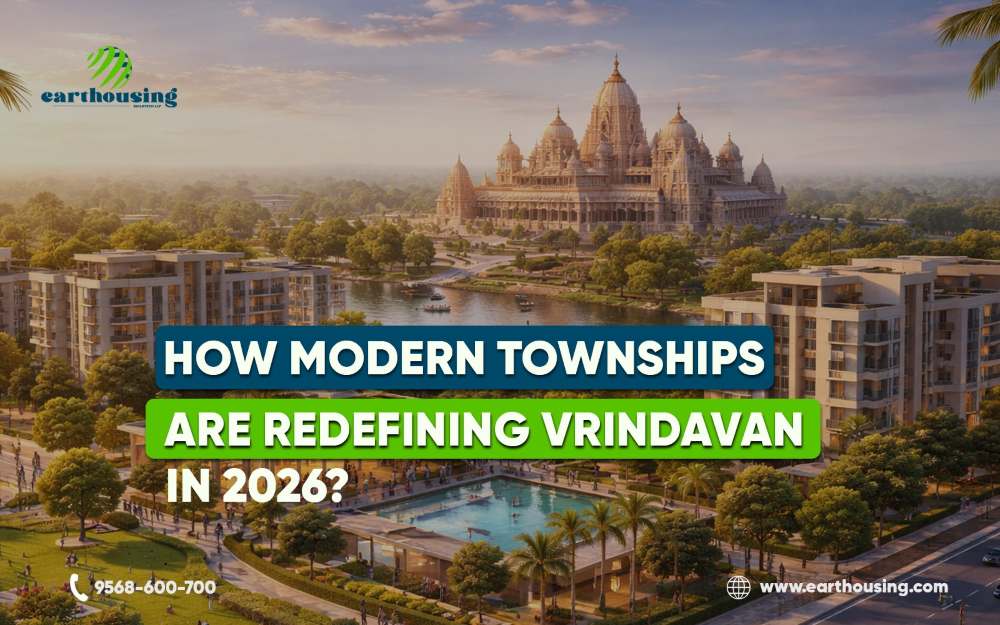
For thousands of years, there has been a long-standing belief that being a "Brajwaasi" (to dwell in the sacred land of Braj) involves a set of physical limitations that can only lead to a deep-soul connection with God. Living in Vrindavan has meant abandoning material comforts to become closer to God. Living in Vrindavan meant walking down narrow, unpaved streets without electricity while living in ancient buildings filled with stories but lacking modern conveniences.
In the year 2026, we are witnessing an incredible evolution in the real estate landscape within this holy city of Vraj. There is still, on the surface, the parikrama marg where the air is filled with the fragrance of sandalwood & the chants of “Radhe Radhe” ring at sunrise. But the landscape has an entirely new appearance. This is a transformational wave of real estate development that has created an unprecedented trend: modern townships in Vrindavan.
These townships are no longer just a place where tired people go to retire; they are dynamic centers of luxury, technology and spirituality! Looking at the real estate trend data from early 2026, we can clearly see that modern townships are not only changing how individuals choose to live in Vrindavan, they are also helping shape the spiritual lives of people living in the 21st Century.
The Evolution of the Modern Pilgrim: Who is Moving to Vrindavan in 2026?
Five years ago, the majority of individuals purchasing homes in Vrindavan were retirees over 60 years old that were looking for vanaprastha. The demographics have significantly changed since then.
Post lockdown, millennials and Generation Z have adopted "spiritual nomadism" as a way of life and are now moving themselves, such as software engineers, artists, and entrepreneurs, to Vrindavan because of both the high vibrational energy and peacefulness of the holy dham. However, they do not want to compromise their quality of life.
Today's modern-day pilgrims require several modern amenities as part of their new lives, namely high-speed fibre-optic internet for their worldwide businesses, 24-hour backup power for local electric outages, and advanced security measures. The ancient city's infrastructure, while being historically appealing, doesn't provide the modern conveniences that today's pilgrims require. The booming market for the village-style community in Vrindavan is due to the creation of a new type of community that provides individuals with the amenities they need to be successful in their cloud-based business while still being grounded on holy ground.
Architecture of the Soul: Designing for "Sattvic" Luxury
The main difference between these latest developments and the concrete jungle surrounding Noida or Gurgaon is the intention behind how they were designed; developers realized by 2026 that they could not just build a development as if it were a standard-style apartment complex that you would find in any metro area and expect it to work for a pilgrimage site within the same environment. Developers are now creating new designs based on the local culture and values of the area.
Many of the leading projects in the area now incorporate elements of traditional "Sattvic" living by integrating modern construction techniques while providing a great deal of emphasis on Vastu Shastra compliant floor plans, thus allowing the energy flow through the home to support meditation and peaceful thoughts. We are beginning to see the industry shift away from heavily-glassed façades that trap heat and move towards ways to incorporate traditional jaali work, courtyards, and natural cooling methods suited to the Braj region.
Additionally, the definition of "amenities" has changed to include a spiritual component. A standard clubhouse has lost its appeal as a selling point, instead, the larger communities are dedicating a significant portion of their space to provide:
In-house Temple Complexes: Elaborate shrines/temples with elaborate deities and prayer spaces are incorporated into the gated communities where residents can participate in Mangala Aarti without having to travel to a temple outside of their gated community.
Meditation Pods and Yoga Decks: Quiet areas have been created that are encircled by gardens with Tulsi plants that were designed specifically to represent the forests of Nidhivan.
Sattvic Community Kitchens: Dining halls that serve pure vegetarian, no-onion/no-garlic meals, catering to those who follow strict dietary sadhana but may not have the time to cook every day.
This is spiritual living engineered for convenience. It allows the resident to focus on their devotion (Bhakti) by removing the daily friction of logistics.
The Infrastructure Catalyst
The real estate boom at this time has a direct correlation to the significant infrastructure investment that has taken place within the region leading up to 2026. The implementation of the Banke Bihari Corridor has facilitated the enhancement of crowd control; however, it has also created a significant divide between "commercial/tourist Vrindavan" and "residential Vrindavan."
As the chaotic centre of the city moves toward an increasing focus on day tourism, many residents are migrating to the outer townships that are connected to the Expressways. In addition to the expansion of the Rail Network, these townships provide seamless access to Vrindavan from Jewar International Airport (now completely operational) for NRIs and international devotees alike.
Therefore, a modern township in Vrindavan, located just off the main highway, will offer an ideal opportunity for NRIs seeking the ultimate "lock-and-leave" scenario. An NRI family can arrive, drive two hours down the expressway, and arrive in pristine, climate-controlled conditions, without having to worry about maintaining an independent property. The concern of property management – such as property encroachment, upkeep, maintenance, or security while living abroad – is completely alleviated.
The Investment Perspective: Why Smart Money is Betting on Braj
From a purely financial standpoint, the graph for Vrindavan real estate in 2026 is outperforming many Tier-2 cities in North India. The supply-demand dynamic is currently skewed. While there is an abundance of unorganized, standalone plots (many with questionable legal titles), there is a scarcity of RERA-approved, high-quality integrated townships.
Investors are realizing that rental yields in Vrindavan are robust and year-round. Unlike hill stations that are seasonal, Vrindavan sees a continuous influx of devotees. However, the modern tourist is discerning. They prefer Airbnb-style rentals within gated societies over traditional dharamshalas. They are willing to pay a premium for clean linens, a swimming pool, and a secure parking spot for their SUV.
Consequently, owning a unit in a township has become a dual-asset strategy: it serves as a personal spiritual retreat for the family and a high-yield rental asset when unoccupied. The appreciation rates in these organized sectors are currently outpacing the stagnating markets of the National Capital Region.
Community and Security
One of the greatest benefits of the modern township of Vrindavan is a reinvigorated community lifestyle. Urbanisation has disconnected people from the traditional "village" form of assistance, but the new townships are bringing that back to life.
In particular, seniors, who are still a large percentage of the population, finds these townships to be an ideal place to live. The geriatric care facilities, on-call physicians and battery-operated vehicles for internal travel give many seniors the security of knowing they can live independently, without any reservations. In addition to the medical services, there is also an element of emotional support. Living in proximity to like-minded neighbours who gather for evening kirtans or Bhagavad Gita study sessions creates a sense of community that is often lost in impersonal apartment buildings. While they are gated and secure townships, they are also communities that have come together to build a better way of life.
Conclusion
Brajwaas have risen because they have the ability to freely walk this spiritual path while retaining access to all of the luxuries of modern day living. The Brajwaas can be awakened by temple bells ringing and not concern themselves with whether or not their water tanks are empty.
Earthousing will continue to be an active participant in the growth that is happening now in Vrindavan; we see a future where Vrindavan will be a model for the world to view as the city of Spiritual Urbanism- A place where the spirit will find rest and the body will be at ease. For those who want to live in the Braj, you no longer have to compromise on your lifestyle. You may now have both modern homes and spiritual havens within the heart of Krishna's land.