
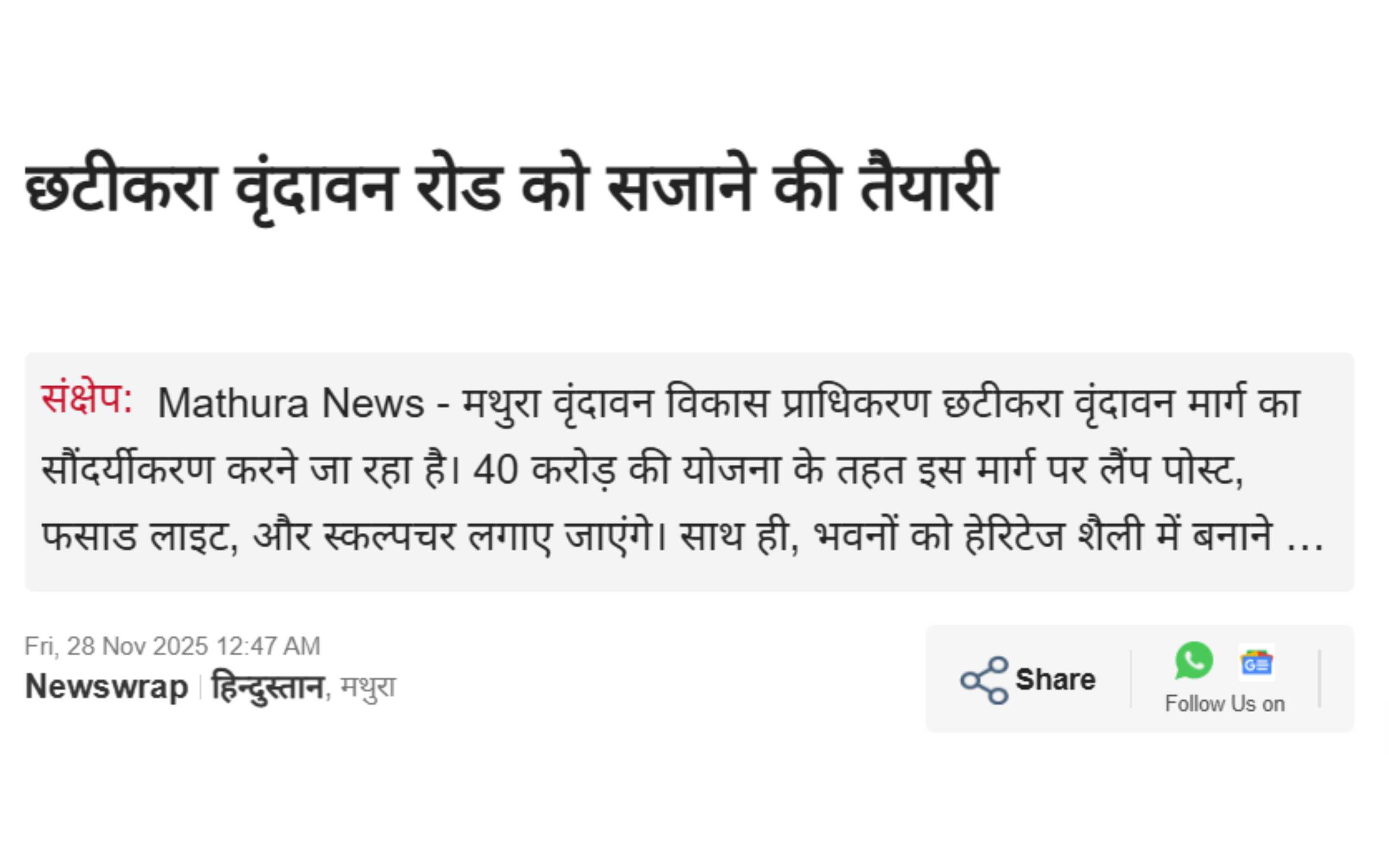
A landmark decision by the Mathura-Vrindavan Development Authority (MVDA) that will reshape the first impression of the Holy City for millions of visitors is its official approval of an extensive beautification programme for Chhatikara to Vrindavan Road. As one of the largest investments in history - ₹40 Crore - this is not just an upgrade to the road; it will become a strategic route that connects Vrindavan with other parts of the world as a global heritage corridor.
This investment announces the commencement of an era of well-organized Urban Planning to all the Developers, Homeowners, and Pilgrims in the Braj area.
The Vision: A Grand Entrance to the Land of Krishna
The Chhatikara Road, which connects National Highway (NH-19) and Vrindavan's Center, has been an effective way for cars, buses and trucks traveling from the Delhi/Agra/Jaypur corridors to enter Vrindavan for many years. There has, however, been an inconsistency with the way in which Chhatikara road has presented the spiritual nature associated with the famous pilgrimage location of Vrindavan.
The MVDA has produced a new plan to create a spiritual theme on Chhatikara, which will support the belief that devotees should experience spiritual feelings upon leaving the highway and before reaching the temple.
According to Shri SB Singh, the Vice Chairperson of the MVDA, the company has now completed the tendering process, and they are ready to begin building the new roadway. "This will create a heritage experience along the entire tourist route as we see in the standard tourist themed areas of Jaipur (where they refer to their city as the Pink City) or the newly constructed areas of Varanasi," he said.
Key Pillars of the ₹40 Crore Makeover
The overall development plan will enhance the aesthetics, environmental sustainability, and cultural identity through a multifaceted investment of ₹40 Crores. Some of the key components of the investment include:
1. The Heritage Look - A Unified Facade for the Main Road
The most prominent element of the plan's feature is using a common painting scheme across the facades of buildings along the main road. The MVDA will paint all buildings and boundary walls in a unified, consistent manner. The colors selected will likely be earth tones or sandstone tones that evoke the traditional architectural forms of the Braj region. This coordinated use of a single color will remove the confusion created by a large collection of disorganized commercial structures along the main road and create a high-quality "blank slate" for the main road promenade.
2. Lighting the Divine - Facade Lighting Features and Decorative Heritage Lamp Posts
As Vrindavan becomes a more prominent evening tourist destination due to the growth of sites like Prem Mandir and the Yamuna Aarti, this plan aims to address this increase by implementing the installation of:
Decorative Heritage Lamp Posts- The plan calls for the replacement of ordinary street poles with decorative heritage lamp posts that reflect Indian artistic heritage.
Facade Lighting- The plan also calls for the installation of facade lighting for key structures to create a warm and spiritual atmosphere during the evening hours.
3. The 10-Kilometer Green Belt
In recognizing that heavy traffic contributes to significant stress on the environment, we are putting together a massive Green Belt, which will span approximately a 10 km section of the roadway. The primary vegetation used will include trees that grow in the local area and have large canopies that produce shade (specifically, mature flowering trees from the area, including Kadamba and Tamarind). This greenbelt will help mitigate the effects of wind-carried dust and air pollution and will also allow thousands of padayatra foot travellers to walk through shaded paths.
4. Artistic Sculptural Installations and Cultural Art
To further develop the notion of storytelling by utilizing the roads, MVDA intends to establish significant artistic sculptures and installations at the most important junctions of the roads and roundabouts. The pieces will be large-scale images depicting Krishna's life and other braj culture symbols (peacock and flute) along with depictions of local saints, providing travellers with a culturally immersive experience beyond just commuting.
Why This Matters to Investors
As large infrastructure projects treat local economies, they create a large increase in local real estate values in general. The Chhatikara-Vrindavan Road is already the highest value real estate zone within this city of Vrindavan. In recent years, this area has seen the development of several prominent residential communities, including Omaxe, Suncity, and Earthousing’s flagship community with properties built by them.
As this beautification process is accelerated, we foresee the following impact(s) on this part of the local real estate market:
1.) Increase in Property Values
History shows that when a municipality invests in ‘placemaking’ (think of creating more beautiful public spaces), surrounding residential communities see a substantial increase in their property values. It is important to note that roads that are beautified through enhanced lighting, landscaping, and a well-designed structure increase the desirability of all surrounding residential parcels. The anticipated increase in property values in these markets of Rukmani Vihar, Sunrakh, and the Ramtal Road via this project in the next 12-18 months is expected to be significant.
2.) Increased Support for Commercial Real Estate
The use of similar building facades and the increased overall appearance via better lighting will significantly increase the commercial potential of this area. Thus, retail showrooms, hotels, and restaurants in Chhatikara will see dramatic increases in their likelihood of attracting more customers, higher foot traffic, and an increased likelihood of attracting a more upscale customer base. This information should be particularly important for investors with commercial land and/or buildings located along this corridor.
3. Enhanced Livability:
For families living in townships off this main road, the quality of life will improve. The green belt reduces noise and air pollution, while better lighting improves safety and security. It reinforces the Chhatikara belt as the "Civil Lines" of Vrindavan—the most upscale and livable zone in the city.
A Stepping Stone to Vision 2030
This project is not being developed in a vacuum and is integrated into a larger plan called Mathura Vision 2030, which includes the Banke Bihari Corridor, Heritage City Close to the Expressway, and the proposed Ropeway System. The government as part of this project has upgraded the main Gateway Entry Point to demonstrate its commitment to making Vrindavan a Global Spiritual Tourism Destination and to provide support to international visitors by developing a world-class infrastructure.
Conclusion
The roads of Chhatikara leading into Vrindavan have been beautified as part of an overall civic improvement. This beautification process also allows for the restoration of the dignity of this sacred space. Whether you are an investor or a developer, the beautification and the subsequent upgrading of the infrastructure upon which it will reside sends a direct message: It's time to consider investing in premium, infrastructure-connected properties located within Vrindavan, which will provide a tremendous opportunity to capture ongoing growth.
At Earthousing, we have always believed that this corridor has tremendous potential to develop into a modern classic. We have a number of projects in close proximity to the intersection of Chhatikara and Ramtal Road, which are designed to integrate beautifully with the new Vrindavan. The ongoing development of the new Vrindavan represents an unparalleled opportunity to own a part of this remarkable experience.
All investors should capitalize on this amazing opportunity to be a part of history and benefit from the rapid growth of this city.