

Vrindavan Gets Bigger on India's Spiritual Tourism Map
The UP government launches the Neem Karoli Baba Circuit with an Rs 12.93 crore investment, and Vrindavan's Samadhi Temple is central to the new pilgrimage route.
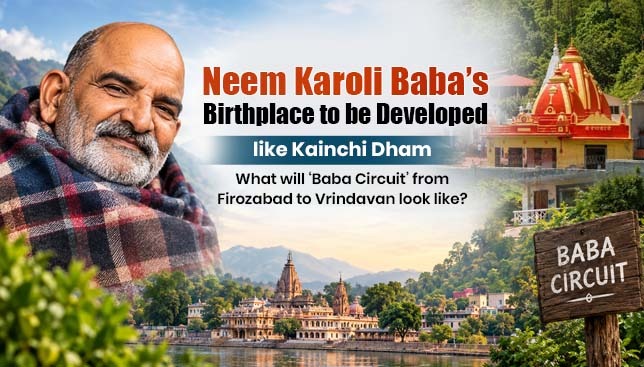
The Union and state governments have found another reason for millions of devotees to come here, and this time it is to build the infrastructure to bring them here. The Department of UP Tourism has officially launched the Neem Karoli Baba Circuit, a dedicated pilgrimage route connecting 4 sacred sites linked to the revered 20th-century saint. The town of Vrindavan is at its core, where Baba attained his Mahasamadhi in 1973. It's being backed by an investment of around Rs 12.93 crore at different locations in Firozabad, Farrukhabad, and Lucknow and is a clear indication of a government desire to attract new spiritual tourists to the fastest-growing religious real estate hub in India.
"The new Neem Karori Baba Circuit will add a meaningful dimension to Uttar Pradesh's famous spiritual tourism offerings by bringing together key places associated with the saint." - — Amrit Abhijat, ACS & DG Tourism, Uttar Pradesh
What the Circuit Covers
This circuit takes the reader to four places in UP, which represent four stages of Baba's life. Vrindavan is known for the Samadhi Temple, where it is believed that he exchanged his mortal body, and it has been a place of devotion for more than half a century. His birthplace is Akbarpur village in the town of Firozabad. Neem Karoli Baba Ashram Dham Temple, Farrukhabad, is the place where he is said to have meditated for 12 years in an underground temple. It ends at Hanuman Setu Mandir in Lucknow.
The difference from a spiritual branding exercise is the actual monetary investment. The Akbarpur birthplace site, Firozabad, has already been developed with Rs 8.65 crore. A second phase, which costs Rs 2.22 crore, is more than 60% complete and will be completed by December 2026. The facilities planned are a multipurpose hall, a cultural block, an exhibition area on the life and teachings of Baba, a 50-seat cafeteria, dormitories for approximately 60 visitors, and full sanitation facilities. The Farrukhabad ashram development, alone, cost Rs 1.51 crore. A plan to develop a rural tourism project valued at Rs 55.44 lakh has been underway.
Packaged Tourism From Delhi and Lucknow
UP State Tourism Development Corporation (UPSTDC) has brought together official tour packages of the circuit, which are available for two to five days with departure from Lucknow and Delhi. The packages from Delhi also feature a tour to Mathura and Vrindavan and Agra and Firozabad, which means that the visitors travelling on these packages will be at Vrindavan (under any Mathura and Vrindavan leg) as part of a religious package and not just an incidental stop. It is the distinction between a devotee who is planning a day trip and a tourist who has reserved a multi-day tour package, covering accommodations, meals, and tours. The second type is the one that is spending more, and infrastructure is being built for the second type.
The significance of Vrindavan for this reason and for Property Here.
In 2023, the number of tourists in Vrindavan was 7.9 crore. That is estimated to be 14.7 crore by 2030. The annual appreciation of property prices here has been 15-25% over the last 5 years. The UP government raised circle rates by 10-25% in November 2025 for urban Vrindavan, thus acknowledging that real prices have gone far beyond the old benchmarks. A few years ago, premium plots in temple corridors sold at the rate of Rs 15,000-20,000 per square yard; today, they sell for more than Rs 60,000 in certain pockets.
The city already hosts the Banke Bihari Corridor, the upcoming Vrindavan Chandrodaya Mandir (which is also expected to be one of the tallest temple complexes in the world), a planned Mathura-Vrindavan metro line (also expected to be built in the future), and an upcoming Jewar International Airport, which is approximately 90 minutes away. These would have had an impact on property markets on their own. They contribute to the overall understanding of how commercial property areas in and around the major temple complexes in Vrindavan have appreciated by 35% year-on-year in 2026.
The Neem Karoli Baba circuit is unique in that it attracts a new kind of pilgrim to Vrindavan. The saint enjoys a huge cult following among Indian professionals and communities of Indians abroad and, remarkably, also has a significant foreign following, with some people such as Steve Jobs and Mark Zuckerberg referring to his teachings. That kind of believer is more prone to travel, visit longer and longer, and spend more money when they do. But infrastructure and tourism promotion packages make that latent demand into real visits, which are channelled through Vrindavan.
The Film Factor
In 2026, two movies about Neem Karoli Baba were released. Hanuman Ansh has grossed an astounding Rs 200+ crore at the box office, which is an unprecedented figure for a devotional film and is said to have directly led the UP Tourism Department to rev up the circuit launch on Mahasamadhi Diwas. The movies put Baba's name on the lips of millions of people who might not have known much about him, and UP Tourism rushed to meet that moment with a raft of tourism products. That is a critical time. It is not a new circuit that starts achieving mass visibility, but a circuit that already has a loyal audience.
Presidential Attention and National Visibility
Earlier in 2026, President Droupadi Murmu visited Vrindavan and paid floral tributes at the Neem Karoli Baba Samadhi Temple. A president who visits any religious site is likely to attract national attention and, more realistically, enhance security at the site, traffic access, and civic interest in the area. That was a concrete endorsement at the highest political level for Samadhi Temple at Vrindavan, attention that would indicate to institutional investors and big developers that it has significance at the state level.
What This Means If You're Considering Property in Vrindavan
All major pilgrimage cities where such scale of infrastructure has been built by the government – Ayodhya, Kashi, Kedarnath – have seen a rise in property rates within 3-5 years. Vrindavan is much further up that curve than most. The demand exists, and it is present. With 7.9 crore tourists already visiting the country, tourism is high. The road, corridor, and temple development have already been funded and are partially completed.
The Neem Karoli Baba Circuit isn't the only thing that will make a difference. But it's the recent developments in Vrindavan, collectively, that are changing Vrindavan's face into the city that it is becoming, such as the Banke Bihari Corridor, Chandrodaya Mandir, Metro, and Jewar Airport. It is no longer simply a tourist spot to visit. It is being developed as a planned spiritual tourist hub equipped with multi-day facilities, tour packages, and a national brand. That's the kind of change that brings about long-term property value growth, not fleeting speculative bumps.