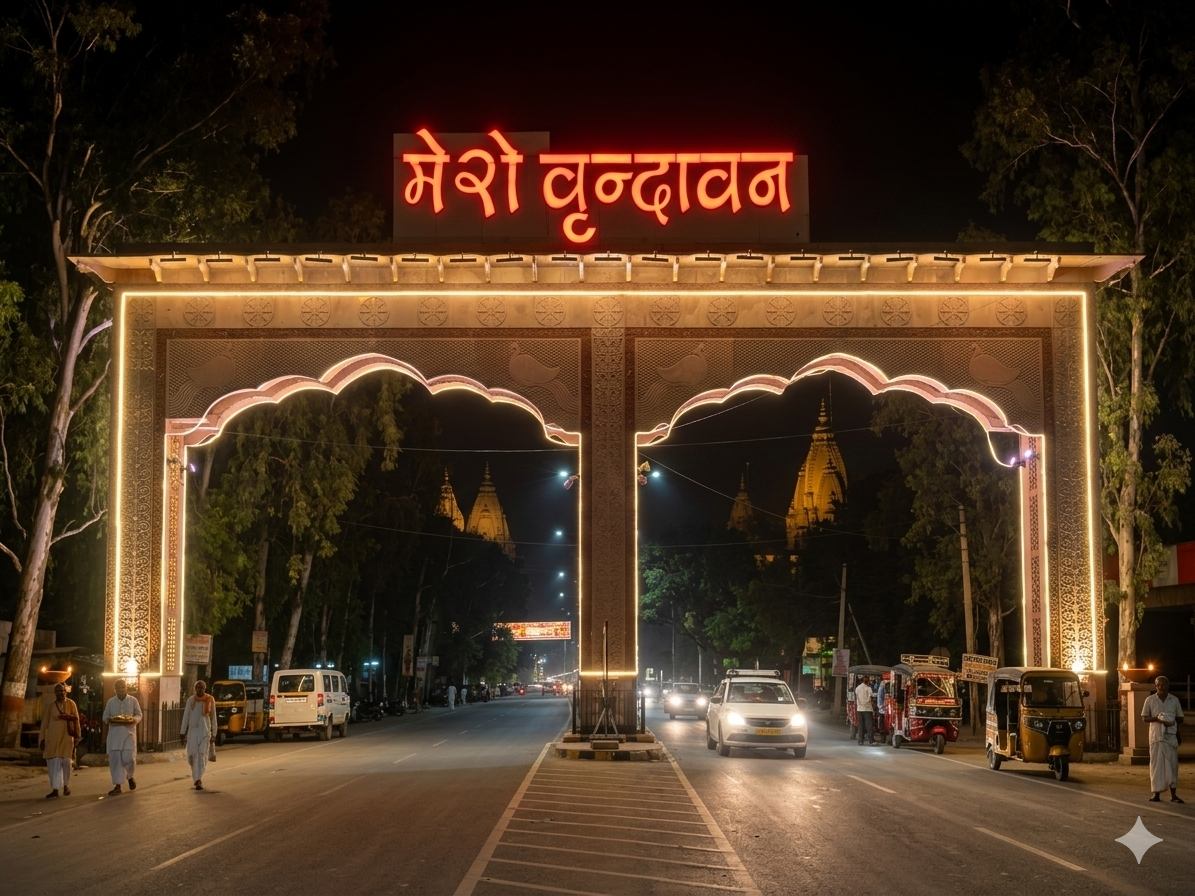
Plot Rate in Vrindavan 2026: What the Numbers Really Mean
Ask three brokers for the plot rate in Vrindavan and you'll get three answers that don't agree with each other. One quotes ₹25,000 per square yard on a far-out colony. Another quotes ₹40,000 on the NH-19 approach. A third, standing near a famous temple, says ₹1 lakh, and honestly, isn't lying. All three are "Vrindavan." None of them are describing the same product.
That spread is really the single most important thing to understand before you buy. The Vrindavan plot price isn't one figure with a bit of noise around it. It's a range that tracks location, road frontage, and the strength of the approval almost perfectly. This page lays out where the rate actually sits in 2026, what pushes it up or down, and where Earthhousing's two NH-19 projects, Shri Vrinda Naivedyam and Shri Vasudhara Vaishaly, fit inside that range.
A quick note on who's writing this. Earthhousing develops and sells plots in Vrindavan, including the two projects discussed below, so read this as a developer explaining its own pricing and the market it sits in. Project details come from our own records. The wider market figures and the Jewar Airport timeline come from public sources you can check yourself.
The Plot Rate in Vrindavan Is a Range, Not a Number
Let's start with the honest version. In 2026, the Vrindavan land price runs anywhere from roughly ₹25,000 per square yard in outlying colonies to around ₹1 lakh per square yard for small plots near the major temples, where demand is high and supply has more or less run out. Most of the active, buildable, approved inventory that ordinary buyers actually purchase sits somewhere in the middle of that band, between ₹35,000 and ₹60,000 per square yard, depending on the corridor.
The temple adjacent ₹1 lakh figure deserves a caveat, because people often quote it to imply the whole town costs that much. Those plots are usually small, sometimes on narrow lanes with no real room to expand, and the title history in the oldest parts of Vrindavan can get tangled pretty easily. You're paying a premium for being able to walk to Banke Bihari, and for some buyers, that's exactly the right trade. But for most buyers who just want a proper plot to build a home on, with a clean registry and a car that can actually reach the gate, that inner town rate isn't really the relevant number.
So when you see a Vrindavan plot price quoted somewhere, the first question isn't "is this high or low." It's "high or low compared to what, in which part of Vrindavan, with which approval." Everything else follows from there.

The NH-19 stretch heading toward Vrindavan, in the Akbarpur and Chhatikara direction, is one of the corridors doing the most heavy lifting in the market right now. It gives you highway frontage, a clean approach into Vrindavan, and proximity to landmarks like Prem Mandir, the
The development stage is the last big factor. A plot with the roads, drainage, water, power, and boundary already built is worth more than a marked out plot in a field with everything promised for "later." A lot of the apparent price difference between two listings is really just the difference between built and promised.
Run any two Vrindavan plots through these four filters, and the price gap usually stops looking arbitrary.
A lot of older content out there still talks about Vrindavan prices rising "after Jewar Airport opens." That framing is simply out of date now. The Noida International Airport at Jewar was inaugurated on 28 March 2026, and commercial flights began on 15 June 2026. It's operating right now. State buses already connect the airport to Mathura and Vrindavan.
What this means for the Vrindavan land price is fairly straightforward. A working international airport within driving distance of the Braj region improves access for pilgrims, tourists, and second home buyers from across India, and that supports demand for plots near Vrindavan over time. The expressway and connectivity projects feeding the airport extend that effect further along the corridors that reach it.
The honest qualifier here: a nearby airport is one demand driver among several, not a switch that lifts every single plot equally. Land with good connectivity, clean approval, and real development stands to benefit the most. A poorly located or weakly titled plot doesn't suddenly become a good buy just because an airport opened nearby. Treat the airport as a tailwind for the right plot, not a guarantee for any plot.
Before you take any Vrindavan plot price seriously, get clear answers on a few things first. Ask for the exact MVDA approval number and confirm it covers your specific plot and phase. Ask what's already built versus what's just promised, road by road and utility by utility. Ask what the registry will actually say, because a registered sale deed in a sanctioned layout is not the same thing as a power of attorney sale on agricultural land. Ask whether a bank will lend against the plot, since the lending market is a genuinely useful second opinion on title. And ask who the developer is and what they've actually delivered so far.
If you want to see how Naivedyam or Vasudhara Vaishaly hold up against that checklist, the fastest way is a site visit, because a finished, approved plot on the ground looks very different from how it reads in a listing. You can book one through the contact details on this site.
In 2026, the plot rate in Vrindavan spans a fairly wide range. Outlying colonies start around ₹25,000 per square yard, while small plots near the major temples can reach about ₹1 lakh per square yard where supply is scarce. Most approved, buildable inventory that ordinary buyers purchase sits between roughly ₹35,000 and ₹60,000 per square yard, depending on the corridor. On the NH-19 approach, Earthhousing's projects are priced from ₹39,990 (Vasudhara Vaishaly) and ₹42,500 (Shri Vrinda Naivedyam) per square yard. Always check location, road width, and approval before treating any single Vrindavan plot price as representative of the whole market.
The Vrindavan plot price is naturally higher closer to the major temple belt, including the Prem Mandir area, because demand is high and developable land is limited, with some inner plots quoted around ₹1 lakh per square yard. Corridors a little further out, such as the Raal Road direction and the NH-19 approach, generally carry a lower plot rate in Vrindavan for a comparable, often larger and better laid out, plot. Earthhousing's NH-19 projects near Akbarpur sit close to Prem Mandir and GLA University while pricing from ₹39,990 to ₹42,500 per square yard. Always confirm the exact distance and approval for any specific plot you're considering.
The Vrindavan land price has risen meaningfully over the last five years, driven by religious tourism, second home demand from Delhi NCR and beyond, and major infrastructure such as the Jewar airport corridor. The exact appreciation varies sharply by location, road width, and approval status, so quoting a single percentage would honestly be misleading. Well located, fully approved, developed plots have held and grown value far better than weakly titled or undeveloped land, which can stall for years. Rather than trusting a blanket growth figure, it's worth comparing actual past transaction rates for the specific corridor you're considering. Developed NH-19 plots have tracked the corridor's rising demand fairly closely.
A 100 gaj plot is 100 square yards, roughly 900 square feet. In 2026, the price depends entirely on location and approval. At an outlying rate near ₹25,000 per square yard, a 100 gaj plot works out to about ₹25 lakh; in the temple belt near ₹1 lakh per square yard, it would cost far more than that. On the NH-19 corridor, at Earthhousing's rates of ₹39,990 to ₹42,500 per square yard, a 100 gaj plot works out to roughly ₹40 to ₹42.5 lakh, though both projects actually start above 100 square yards. It's worth reconverting any quoted total back to a per square yard plot rate in Vrindavan before comparing across listings.
The plot rate in Vrindavan keeps rising mainly because demand keeps growing while developable, approved land near the temples stays limited. Religious tourism brings a steady stream of pilgrims, and a lot of them want a second home somewhere in the Braj region. Buyers from Delhi NCR and other cities add further to that demand. Infrastructure has reinforced this trend too, including the now operational Jewar airport and the expressways feeding it, which have genuinely improved access to the area. The limited supply of clean title, sanctioned plots meeting this rising demand keeps pushing the Vrindavan plot price upward over time, though the increase is strongest for well located, fully approved land specifically.
The cheapest plot rate in Vrindavan for genuinely MVDA approved land tends to sit in the outlying colonies rather than near the temples, where rates run far higher. Be careful here, though. A lot of the cheapest land out there carries weaker tenure, like 143 C conversions or "applied" approval numbers that haven't actually been sanctioned, rather than a full MVDA layout. A low Vrindavan plot price paired with a verified MVDA number, finished development, and a clean registry is really the target you should be aiming for. Always ask for the exact approval number and confirm it covers your specific plot, not just a different phase of the same project.
On average, the Vrindavan land price sits above the Mathura land price. Vrindavan draws a premium from religious tourism and second home demand concentrated near its temples, where supply is genuinely tight. Mathura district, on the other hand, has more developable land spread across its outer tehsils, which pulls its average rate lower. That said, the comparison flips at the level of a specific plot. A well located, fully approved plot on the NH-19 Vrindavan approach can actually cost more than a far off plot elsewhere in Mathura. As with the Mathura plot rate, location, road width, approval, and development stage matter far more than just the town name on the listing.
All three, plus a fourth. Location relative to the temples and the highway is the largest factor by some distance, since land that more people want and that's in shorter supply naturally costs more. Road width in front of the plot matters for resale, construction access, and how the finished home actually feels, so wide road and highway frontage plots command noticeably higher rates. Approval strength is what separates a safe rate from a risky one, since a full MVDA layout is worth considerably more than weaker 143 C or "applied" tenure. The fourth factor is the development stage: a plot with roads and utilities already built is simply worth more than a marked out plot sitting in an open field.
Jewar Airport has already opened, actually. The Noida International Airport was inaugurated on 28 March 2026, with commercial flights beginning on 15 June 2026, and state buses now connect it to Mathura and Vrindavan. A working international airport within driving distance supports demand for plots near Vrindavan from pilgrims, tourists, and second home buyers, which over time supports the Vrindavan plot price. The honest qualifier here: the airport is one demand driver among several, and it helps well located, approved, developed plots the most. A weakly titled or poorly located plot doesn't become a good buy simply because the airport is now operating nearby.
The Vrindavan plot price per square yard is generally lower on the NH-19 approach than in the inner temple areas, where small plots can reach about ₹1 lakh per square yard against very tight supply. The NH-19 corridor near Akbarpur and Chhatikara offers highway frontage, a clean approach, and proximity to landmarks like Prem Mandir, all at a much more workable plot rate in Vrindavan. Earthhousing's NH-19 projects are priced from ₹39,990 (Vasudhara Vaishaly) and ₹42,500 (Shri Vrinda Naivedyam) per square yard, with larger, developed, MVDA approved plots on offer. The trade here is location for rate: less old town proximity, in exchange for more developed and buildable land.